Common Errors in the Retort Process and How to Avoid Them
Introduction to the Retort Process and Its Significance in the Food Industry
The retort process is one of the most important sterilization technologies in the food industry. Errors in the retort process can have serious impacts on product quality and safety. As a food preservation method that uses high-pressure thermal treatment, retort processing is critical to ensuring that packaged food products remain safe for consumption with a long shelf life.
According to data from mesinretort.com, a leading retort education portal in Indonesia, this process is commonly used for food packaged in cans, pouches, or bottles that require commercial sterilization. The significance of the retort process cannot be underestimated, as failures in its execution can lead to microbiological contamination that is hazardous to consumers.
The food industry in Indonesia increasingly relies on retort technology for products such as processed meats, fish, vegetables, and ready-to-eat meals. However, problems in the retort process still occur frequently, especially in production facilities with limited experience or insufficient technical knowledge.
Common Errors in Preparation and Initial Setup of the Retort Process
The preparation and initial setup stage is the foundation of a successful retort process. Some common errors that frequently occur at this stage include:
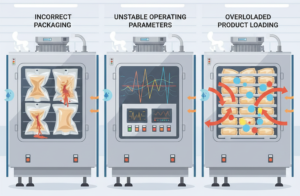
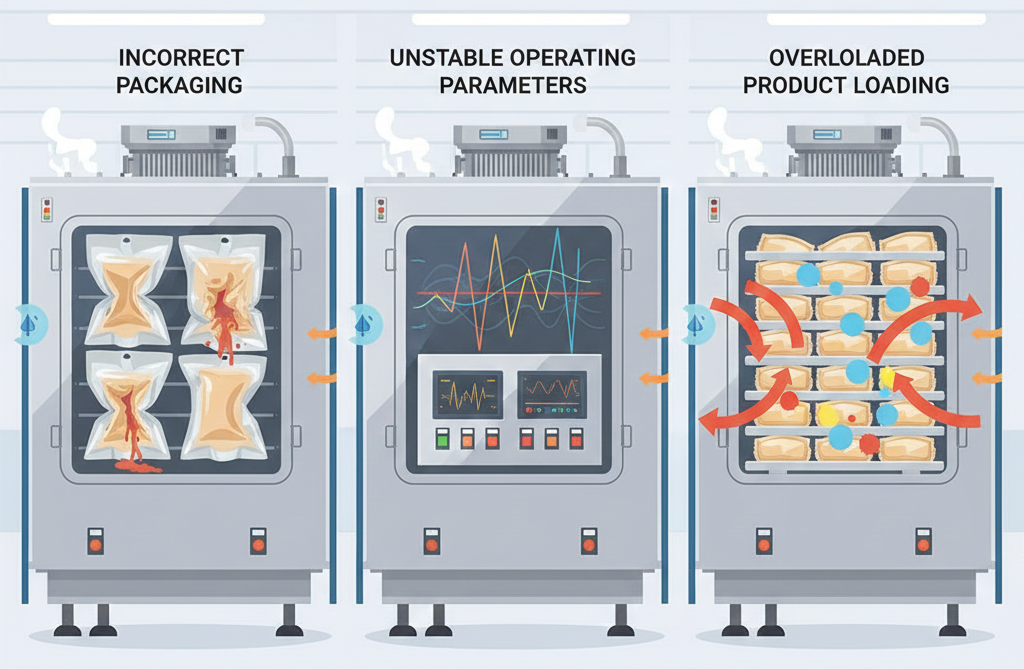
1. Improper Selection of Packaging
One critical retort process error is the use of packaging materials that are not heat-resistant. As reported by jualmesin.co.id, not all plastics have the same resistance to high temperatures. Packaging intended for retort processing must have specific properties such as:
- Resistance to temperatures of 121°C or higher
- Good barrier properties against oxygen and water vapor
- Ability to withstand high pressure during the process
Materials such as standard LDPE or PP are not suitable for retort processing and may melt or release harmful substances into the product.
2. Incorrect Machine Configuration
Improper setting of retort machine parameters is a frequent source of retort sterilization failure. According to mesinretort.com, common configuration errors include:
- Temperature settings that do not match the product type
- Sterilization time that is too short
- Insufficient pressure for heat penetration throughout the product
- Inaccurate calibration of temperature sensors
3. Non-Optimal Product Loading
Uneven or overly dense loading inside the retort machine can result in uneven heat distribution. News portal mesinretort.com states that products must be arranged properly to ensure optimal circulation of the heating medium (steam or water).
Critical Issues During Retort Sterilization Operation
The operation phase is a critical point where many retort process problems occur. The following are several errors that should be avoided:
1. Unstable Temperature Control
According to news.kokikit.com, temperature control issues are among the most common problems. Temperature fluctuations during the sterilization process can result in:
- Underprocessing, which risks leaving harmful microorganisms
- Overprocessing, which degrades sensory quality and nutritional value
- Uneven heat distribution across the entire product batch
It is essential to have a real-time temperature monitoring system and automatic alarms when deviations from the defined parameters occur.
2. Issues with Heating Medium Quality
Poor-quality water or other heating media can lead to common retort failures. As noted by inagi.co.id, mineral deposits in water can interfere with heat transfer and cause damage to retort machine components.
3. Power Outages or Utility Disruptions
Utility disruptions such as power outages or inconsistent steam pressure can interrupt the retort cycle. Products affected by sterilization process interruptions must be carefully evaluated to determine whether they should be reprocessed or discarded.
Errors in the Cooling Phase and Post-Retort Handling
The cooling and post-retort handling phase is often overlooked, even though it is just as important as the sterilization phase itself.
1. Cooling That Is Too Rapid or Uneven
Excessively rapid cooling can cause thermal shock to products and packaging, potentially resulting in:
- Leaking or damaged packaging
- Undesirable changes in product texture
- Incomplete vacuum formation in canned packaging
According to supplysidesj.com, cooling must be carried out in a controlled manner with continuous monitoring of product temperature until a safe level is reached.
2. Improper Product Handling After Retort
Rough handling of products after the retort process, especially while they are still hot, can cause package deformation and potential leakage. Mesinretort.com recommends:
- Waiting until products reach approximately 40°C before intensive handling
- Using conveyor systems or specialized handling equipment to minimize manual contact
- Inspecting package integrity immediately after the retort process
3. Failure of Documentation and Monitoring Systems
According to packagingmic.com, poor or incomplete documentation is a common post-retort error. Each product batch must have complete records of process parameters, including:
- Temperature profiles during sterilization and cooling
- Pressure inside the retort
- Processing time
- Operator and supervisor identification
- Results of package integrity testing
Troubleshooting Strategies and Retort Process Optimization
To address various issues in the retort process and achieve retort process optimization, the following strategies are recommended:
1. Implementation of a Preventive Maintenance Program
Mesinretort.com emphasizes the importance of routine maintenance to prevent system failures. This program should include:
- Periodic inspection of critical retort machine components
- Routine calibration of temperature and pressure sensors
- Cleaning of piping systems and filters
- Monitoring the quality of water or other heating media
2. Training of Operators and Technical Staff
Many retort sterilization failures stem from operators’ lack of understanding of the basic principles of the retort process. According to inagi.co.id, comprehensive training programs should cover:
- Fundamental principles of thermal sterilization
- Operation and troubleshooting of retort machines
- Understanding of Critical Control Points in the process
- Emergency procedures in the event of process deviations
3. Process Validation and Verification
Effective retort process troubleshooting requires a robust validation program. This involves:
- Heat distribution studies to ensure uniform heat penetration
- Verification of sterilization effectiveness through microbiological testing
- Challenge testing using heat-resistant bacterial spores to verify process effectiveness
- Periodic review and analysis of process data to identify trends or potential issues
4. Adoption of Advanced Monitoring Technologies
Mesinretort.com recommends the use of advanced monitoring technologies for retort process optimization, such as:
- Integrated automatic data logging systems
- Wireless temperature sensors for real-time monitoring
- Process data analysis software for prediction and anomaly detection
- Intelligent alarm systems capable of early detection of process deviations
By implementing the strategies above, the food industry can minimize retort process errors and ensure safe, high-quality products.
The retort process is a critical technology in the food industry that requires deep understanding and precise implementation. By identifying common errors and applying effective preventive strategies, manufacturers can ensure product safety and meet expected quality standards.
For more information on retort technology and solutions to common issues, visit mesinretort.com, a leading educational portal in Indonesia dedicated to retort technology.